
Heart disease in gorillas might sound like a funny topic for a garden blog, but I firmly believe what we eat directly affects our health and it stands to reason diet affects the health of gorillas too. Gorillas in captivity are succumbing to heart disease and scientists are looking at their diet to see if that might have something to do with their heart problems. In the wild, gorillas prefer to eat the shoots of a plant called Grains of Paradise, Aframomum melegueta, or Guinea pepper and the gorillas live much longer and healthier lives than those in zoos. African healers have used this same plant to treat infections for centuries and in West African villages visitors to homes eat the seeds of the plant before any discussions take place.
Scientists are researching Aframomum and the results look promising for the antimicrobial and anti-inflammatory properties of this plant. Future antibiotics or arthritis drugs may be derived from the Aframomum plant. When you think about it many of our modern day medicines are derived from plants such as aspirin from willow bark, digitalis from foxglove, penicillin from orange mold, codeine and morphine from the poppy, and many more.
So if you plan on cooking something, add some herbs and spices, besides making your food taste better, you never know what health benefits you may be getting from the herbs, spices and food you eat.
Showing posts with label herbs. Show all posts
Showing posts with label herbs. Show all posts
Saturday, April 5, 2008
Friday, April 4, 2008
Raised Planting Bins
Raised planting bins are really useful for so many reasons. 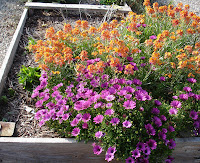 To name a few: the soil in the planting bins heats up earlier in the season than the ground does, the soil doesn't get compacted from walking on, the soil drains well, planting and harvesting of herbs, vegetables or flowers from bins is easier because you don't have to bend over as far, underground varmints can't eat the roots, and there is less damage to young seedlings by crawling insects, slugs or snails.
 The photo on the right shows our row of bins. This time of year the bins don't look like much because the plants are so small, but wait a month or two and you won't be able to see the bins at all due to the size of the plants. I have alyssum planted in the center of the bins to help attract bees for pollination. We constructed our bins from recycled lumber. There was a corral behind our barn and since we weren't going to have cows or horses we tore the corral down and used the posts and boards for our bins, our grape support system and our wisteria arbor. Recycled lumber can be found most any place, even old doors can be used. I would not recommend using treated lumber or railroad ties for vegetables bins as chemicals used in the wood may leach into the soil and be taken up by the plants.
Since we have lots of gophers here, we placed aviary wire on the bottom of each bin so gophers could not burrow up from the ground. Then we placed the boards on top of the soil and screwed 4x4 posts inside each corner for support. The bins are 12 feet long x 2.5 feet wide and 20 inches tall. The lumber we had happened to be 12 feet long so we just kept it to that dimension We mixed native soil with about a third compost and placed this in the bins, watered them well and if the mixture settled, we added some more, keeping it about two inches below the top. To the left you see my pepper bin, smaller than the other bins. I use baskets for my tomatoes, peppers and flowers to keep the wind from blowing them over. In each bin, we placed ground cover cloth over the top of the soil. We cut X's in the cloth every two feet and that's where we plant the vegetables, herbs or flowers. The less soil exposed, the less weeding we have to do. We have placed bark on top of the ground cover cloth. Both the ground cover cloth and the bark help to retain moisture in the summer months. I rotate my vegetables to different bins each year as each plant requires different nutrients. This will be the fourth year for the wood bins and they are still holding up.
If you can afford the cost, I recommend building bins from cinder blocks. The advantage of cinder block is they don't rot like wood does and the hollow space in the center of the block is an insulator for the soil. When we lived in Arkansas we made bins from cinder blocks with a block top cap. We could sit on the top cap to harvest our herbs, vegetables and flowers. We did not use mortar to build them, so if we ever wanted to move the bins, we could just take the cinder blocks down. We placed the cinder blocks four high and overlapped the seams. We made the block bins about 4 foot square.
With a little effort and time, you can construct your own bins, even in a limited planting area, and reap the rewards of your harvest.
 To name a few: the soil in the planting bins heats up earlier in the season than the ground does, the soil doesn't get compacted from walking on, the soil drains well, planting and harvesting of herbs, vegetables or flowers from bins is easier because you don't have to bend over as far, underground varmints can't eat the roots, and there is less damage to young seedlings by crawling insects, slugs or snails.
 The photo on the right shows our row of bins. This time of year the bins don't look like much because the plants are so small, but wait a month or two and you won't be able to see the bins at all due to the size of the plants. I have alyssum planted in the center of the bins to help attract bees for pollination. We constructed our bins from recycled lumber. There was a corral behind our barn and since we weren't going to have cows or horses we tore the corral down and used the posts and boards for our bins, our grape support system and our wisteria arbor. Recycled lumber can be found most any place, even old doors can be used. I would not recommend using treated lumber or railroad ties for vegetables bins as chemicals used in the wood may leach into the soil and be taken up by the plants.
Since we have lots of gophers here, we placed aviary wire on the bottom of each bin so gophers could not burrow up from the ground. Then we placed the boards on top of the soil and screwed 4x4 posts inside each corner for support. The bins are 12 feet long x 2.5 feet wide and 20 inches tall. The lumber we had happened to be 12 feet long so we just kept it to that dimension We mixed native soil with about a third compost and placed this in the bins, watered them well and if the mixture settled, we added some more, keeping it about two inches below the top.
 To the left you see my pepper bin, smaller than the other bins. I use baskets for my tomatoes, peppers and flowers to keep the wind from blowing them over. In each bin, we placed ground cover cloth over the top of the soil. We cut X's in the cloth every two feet and that's where we plant the vegetables, herbs or flowers. The less soil exposed, the less weeding we have to do. We have placed bark on top of the ground cover cloth. Both the ground cover cloth and the bark help to retain moisture in the summer months. I rotate my vegetables to different bins each year as each plant requires different nutrients. This will be the fourth year for the wood bins and they are still holding up.
If you can afford the cost, I recommend building bins from cinder blocks. The advantage of cinder block is they don't rot like wood does and the hollow space in the center of the block is an insulator for the soil. When we lived in Arkansas we made bins from cinder blocks with a block top cap. We could sit on the top cap to harvest our herbs, vegetables and flowers. We did not use mortar to build them, so if we ever wanted to move the bins, we could just take the cinder blocks down. We placed the cinder blocks four high and overlapped the seams. We made the block bins about 4 foot square.
With a little effort and time, you can construct your own bins, even in a limited planting area, and reap the rewards of your harvest.


Saturday, March 8, 2008
A Little Bourbon Never Hurt Anyone !
 Lavender isn't the only edible plant I grow in my gardens. I also grow other herbs, vegetables and fruits too. You probably guessed I love gardening, but I also love cooking. So I am always looking for ways to incorporate what I grow in the gardens into various recipes. From time to time here I will post recipes I have tried using ingredients grown locally or grown right here in my gardens. As we all know home grown produce always tastes much better than store bought. The best reason I can think of is that the ingredients we get from our gardens or those that are grown locally are fresher. A great place to find local farmers in your area growing sustainably grown products is Local Harvest. Please check this organization out, they are a great resource and are doing a wonderful service for their members and for the public who wish to support their local economy and farmers.
Now you are probably wondering what bourbon has to do with gardening? Well there could be a lot of reasons, as I am sure many could attest to.
 But in this case, I was searching for a recipe to bring to a local dinner group I belong to, when I remembered having some delicious Bourbon Yams at a Ventura County Potters Guild ceramics workshop I attended recently. Since yams are in season in the winter, I wanted to try making Bourbon Yams to bring to the dinner group. Here is the recipe for bourbon yams.
8 yams
2 cups dark brown sugar
1/2 cup heavy cream
1/2 cup bourbon
1/4 lb butter
3/4 cup pecans - chopped
Brown the pecans in a small amount of butter in a skillet and set aside.
Boil the yams for 12 minutes with water just covering them and drain immediately and put in cold water with ice added to stop the cooking process. After they are cool, peel and slice them.
In a large saucepan, melt the butter, add the brown sugar and cook till slightly thick. Then add the bourbon and heavy cream and blend together. Add in the sliced yams and mix around to coat them with the sauce. Then add in the pecans and mix around to distribute the nuts.
Put into a greased glass pan 13 x 9 and bake for 25 minutes at 375 (put a tin foil covered baking sheet underneath to catch anything that might bubble over.
I hope you enjoy these yams as much as I did. If you have any recipes to recommend, please feel free to recommend them to me.
Subscribe to:
Posts (Atom)


